
Am I Entitled to a Clerk-Magistrate Hearing in Massachusetts?
Am I Entitled to a Clerk-Magistrate Hearing in Massachusetts?
A clerk-magistrate hearing can be one of the best opportunities to prevent a criminal charge from moving forward. Before you are brought before a judge for arraignment, you may have a chance to challenge the allegation and persuade the clerk not to issue a complaint.
The first question is whether you qualify.
As a general rule, you are entitled to a clerk-magistrate hearing if you are accused of a misdemeanor and were not arrested for that offense. G.L. c. 218, § 35A.
Received a clerk-magistrate hearing notice? Call (857) 415-2415 for a free, confidential assessment, or send a message below.
There are exceptions, discussed below. But that basic rule is where I start when reviewing a potential case. If you qualify, the next step is to preserve the opportunity and prepare to make the most of it.
Why getting a hearing matters
At a clerk-magistrate hearing, sometimes called a show-cause hearing, the question is whether a criminal complaint should issue. You have an opportunity to address the accusation before arraignment.
That gives your attorney two useful avenues to explore. The first is whether the evidence actually supports the charge. The second is whether an appropriate resolution can be reached without issuing a complaint.
Those are different arguments, and preparation helps determine which deserves the most attention. Sometimes a police report leaves out a fact that changes the meaning of an incident. Sometimes the evidence supports an allegation, but the circumstances give the clerk a reason to consider another approach.
My objective is to identify the strongest available argument and present it clearly.
Start with the charge and the paperwork
Send me the hearing notice, citation, or summons, including any instructions on the back. I want to identify the alleged offenses, whether you were arrested, and what the court has scheduled.
A notice of a clerk-magistrate hearing means we can begin preparing for that hearing. A criminal motor-vehicle citation may require an immediate written request. A summons for arraignment calls for a review of whether you should have received a hearing first.
The exact charge matters. An everyday description such as “assault,” “theft,” or “leaving the scene” does not always tell us whether the particular offense is a misdemeanor or felony. Reviewing the statute and the application helps answer that question.
When does the misdemeanor rule have exceptions?
Section 35A permits the usual hearing opportunity to be bypassed where there is an imminent threat of bodily injury, commission of a crime, or flight from Massachusetts. Read the statutory exceptions.
If an exception is asserted, I want to examine the facts supporting it. The useful question is whether the circumstances justify proceeding without the hearing you would otherwise receive.
If you have already received an arraignment summons, an attorney can review the complaint application and determine whether there is a basis to request relief before arraignment. Addressing that issue promptly gives us the best opportunity to raise it at a useful stage.
Can I get a hearing for a felony?
A felony allegation does not carry the same general entitlement. However, a law-enforcement applicant may request a hearing. For a felony application brought by someone other than law enforcement, the court has discretion to provide one. The statute’s other limitations still apply. G.L. c. 218, § 35A.
In an appropriate case, it is worth asking the police to request a hearing before the complaint issues. That request should have a reason behind it: important evidence that has not been considered, a disputed account, or circumstances that deserve a closer look.
This is one benefit of speaking with a lawyer early. We can assess whether a hearing is available and take steps to seek it while the decision is still being made.
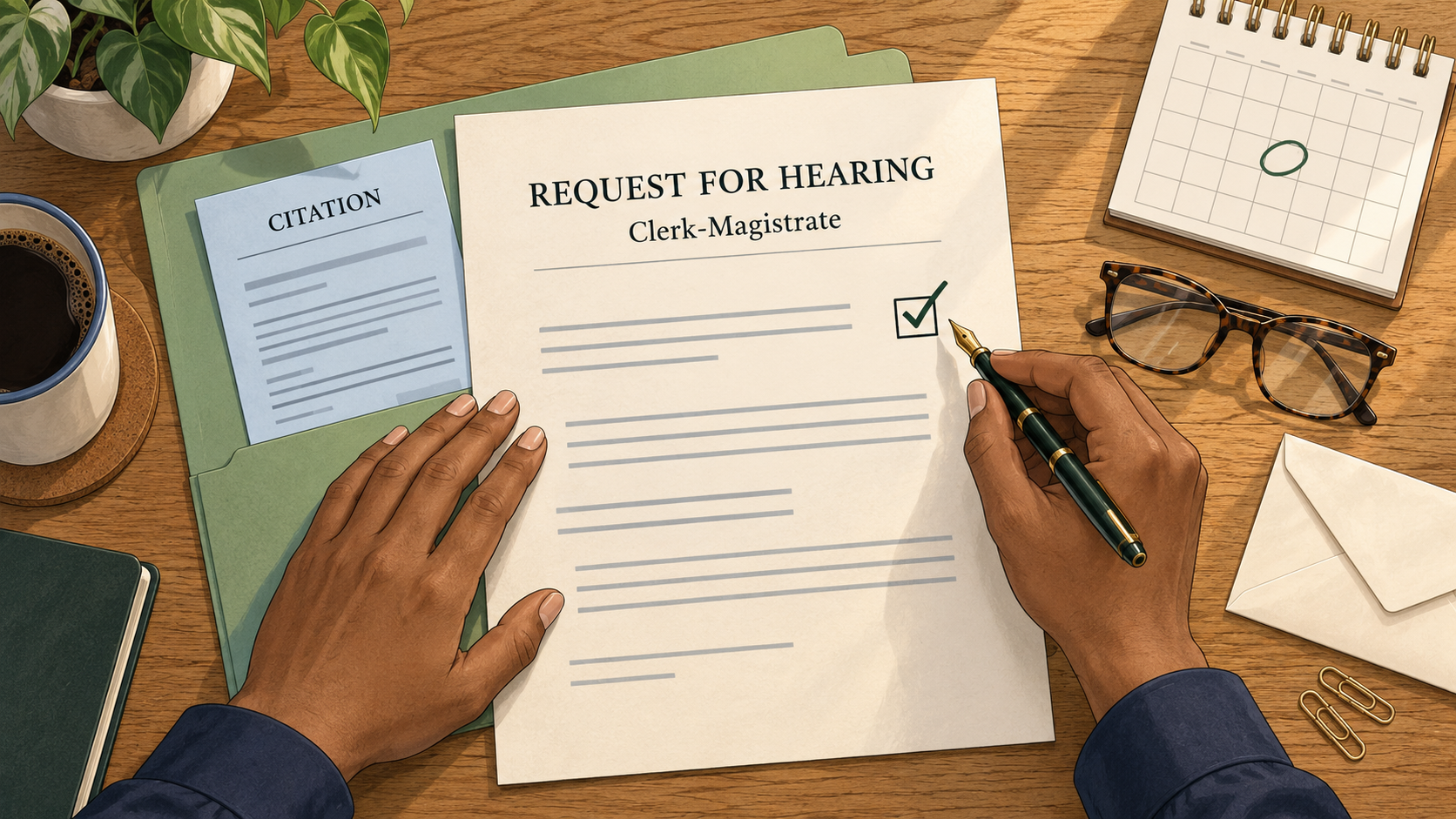
Received a criminal motor-vehicle citation? Check the deadline.
If you receive a qualifying criminal motor-vehicle citation alleging a misdemeanor with no accompanying felony, the law requires a written hearing request within four days of the violation. The request goes to the clerk-magistrate of the District Court where the offense occurred. G.L. c. 90C, § 3(B)(2).
This is different from the 20-day procedure for contesting a purely civil traffic ticket.
If your citation indicates that the officer is applying for a criminal complaint, send it to your attorney promptly. We can identify the correct court, review the instructions, and help preserve your hearing opportunity. Keep a copy of the request and proof of submission.
If you think the deadline has passed, have the paperwork reviewed anyway. The dates, delivery circumstances, and current status of the application will help determine what can still be requested.
Prepare evidence that answers the allegation
Once the hearing is scheduled, preparation should focus on what will help the clerk evaluate the case.
I start by comparing the available evidence with the elements of the proposed offense. What must be established? What does the report actually show? What information is missing?
A complete message exchange may explain something that looks incriminating in a single screenshot. Photographs may contradict an assumption about an accident. A witness may supply context that never made it into the police report.
You can help by preserving relevant messages, photographs, receipts, recordings, and witness information. Put together a short chronology for your lawyer while the details are fresh.
We should also decide whether you will speak and how your account should be presented. Having a plan allows you to approach the hearing with a clearer understanding of what matters and less worry about what you are supposed to say.
Explain the circumstances that the report leaves out
The legal argument is only part of the preparation. I also want to understand your work, education, family responsibilities, community involvement, and prior history.
Where an appropriate alternative is available, those facts may help explain why issuing a complaint is unnecessary. Treatment, restitution, or another practical response may also be worth discussing, depending on the allegation.
The point is to give the decision-maker useful information. A police report describes an incident. It rarely provides a complete picture of the person involved or the options for resolving the matter.
I consider both the evidence and the personal circumstances so we can present the strongest position the case supports.
For a concrete example, read how I prevented a shoplifting complaint from issuing in Haverhill despite surveillance video. The result turned on presenting my client’s circumstances and explaining why prosecution was unnecessary.
How can this protect my record?
Preventing a complaint before arraignment can have significant benefits for someone concerned about employment, school, or professional opportunities.
Massachusetts’ definition of CORI limits it to information recorded in criminal proceedings that are not dismissed before arraignment. That is an important reason to take the hearing seriously. Police reports and other records may still exist, but avoiding a complaint and arraignment can prevent the allegation from progressing into a criminal case on your CORI. G.L. c. 6, § 167.
Early preparation gives us an opportunity to pursue that result before the case moves further.
Find out whether you qualify
If you received a citation, hearing notice, or summons—or police have told you they intend to seek charges—call Winn Law, P.C. at (857) 415-2415 for a free consultation.
I can review the paperwork, explain whether you qualify for a hearing, identify any deadline, and develop a plan for opposing the complaint. Understanding your options and having someone handle the preparation can also take much of the uncertainty out of the process.
Learn more about my representation at clerk-magistrate hearings throughout Massachusetts.
For more about the hearing itself, read What Happens at a Clerk-Magistrate Hearing?.
From the Blog




Get in Touch
Over 50 five-star reviews on Avvo. For a free, confidential case assessment, tell us briefly what happened and how to reach you using the form below, or call (857) 415-2415


