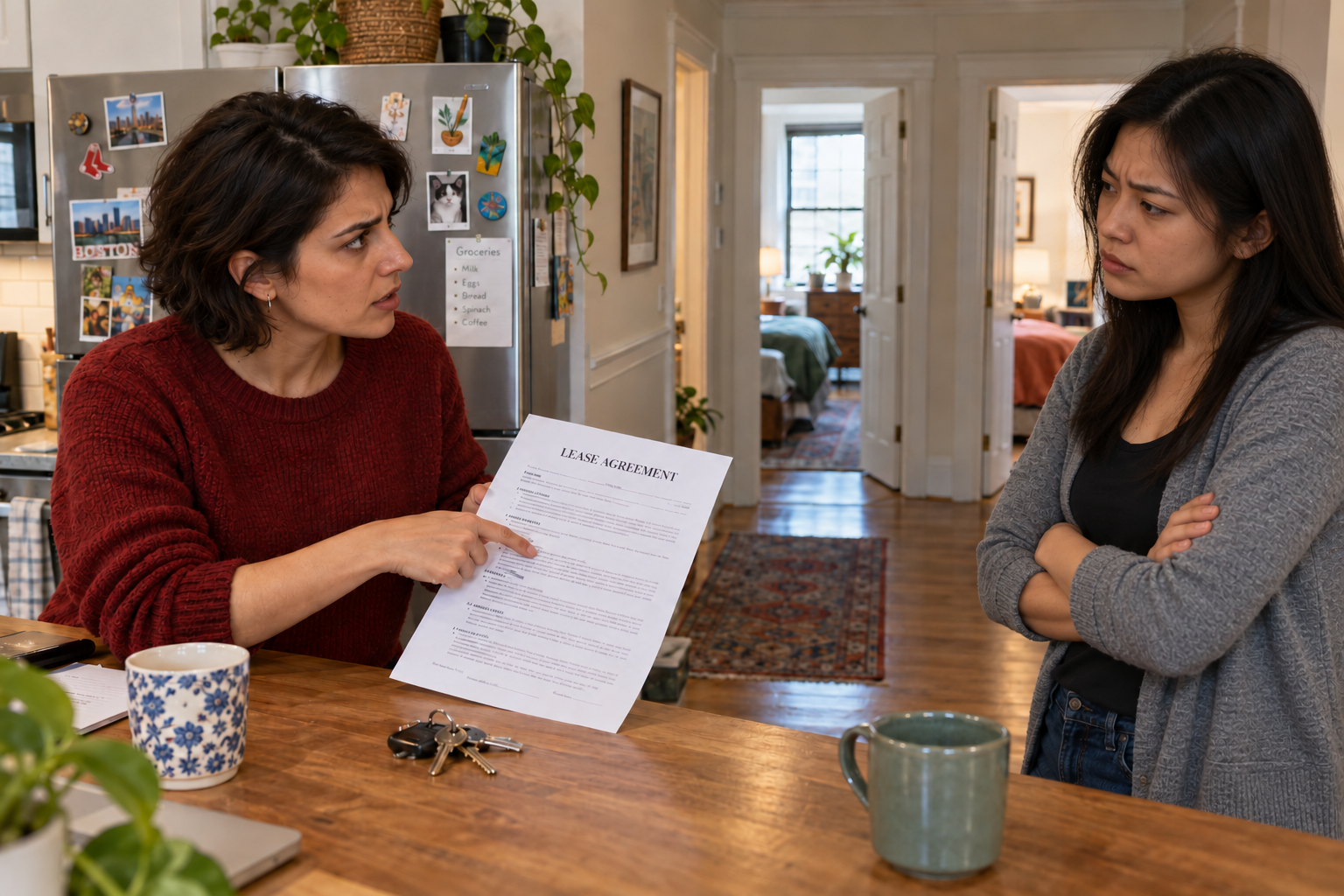

Accused of a Crime After a Roommate Dispute in Massachusetts?
By Attorney Patrick M. Winn
A disagreement about rent or electricity can make an apartment an unpleasant place to live. Once the police become involved, it can also leave you facing the prospect of a criminal case.
At that point, the question becomes more specific. What crime are you accused of committing, and does the evidence establish the elements of that offense?
A recent clerk-magistrate hearing at Newton District Court illustrates why that question matters. Police sought a criminal complaint against my client after her roommate accused her of shutting off electricity. I submitted evidence that my client was neither the roommate’s landlord nor her lessor. Because that relationship was required for the proposed charge, the clerk found no probable cause. No criminal complaint issued.
Can a roommate dispute lead to criminal charges in Massachusetts?
Yes. Sharing an apartment does not prevent an allegation from becoming a criminal matter. In fact, it can make a dispute more concerning to a prosecutor, given the emotional intensity and close physical proximity of the parties.
But describing an argument in a police report does not establish every element of a crime. A report may contain a detailed account of an unhappy living arrangement while leaving a necessary legal question unresolved.
When I review an application for a criminal complaint, I examine both the account of what happened and the law under which the police are seeking to proceed. Sometimes the strongest defense concerns a fact that receives very little attention in the narrative.
The Newton case: an allegation of shutting off electricity
The case arose from a dispute between two women sharing an apartment in Wilmington. Police responded after one roommate reported that electricity had been turned off. The application sought a complaint for failure by a landlord to provide utilities under G.L. c. 186, § 14.
That statute addresses specified misconduct by a landlord or lessor, including intentionally failing to furnish required utilities and interfering with their provision. For the proposed charge, my client’s legal relationship to her roommate was an essential part of the analysis.
The police account described an arrangement in which my client received a monthly payment from her roommate and paid the utility bills. Those facts deserved examination. They did not end the inquiry.
The lease provided the critical evidence.
What the lease actually established
Both women were named as residents under the property owner’s lease. The documents supported a direct tenancy for each of them, rather than an arrangement in which one woman obtained her right to occupy the apartment solely through the other.
That distinction mattered. One roommate’s handling of household payments did not, by itself, resolve whether she was the other’s landlord.
I submitted the lease evidence at the hearing and argued that the landlord-or-lessor requirement was not satisfied. The clerk agreed and found no probable cause.
My client avoided arraignment on the allegation. The result came from identifying a required element of the proposed offense and presenting documents that addressed it directly.
Does collecting money from a roommate make you a landlord?
The answer depends on the actual arrangement. A person can rent an apartment and then sublet all or part of it to someone else. Ownership is not the only way to become a lessor. Calling someone a “roommate” does not settle the issue either.
For that reason, I would not approach every shared-apartment case with the same argument. I would examine who granted each person the right to live there, what the agreements say, and how the arrangement operated.
Useful questions include:
- Are both occupants named as tenants on the owner’s lease?
- Is there a separate agreement granting one person occupancy through the other?
- What does the monthly payment cover?
- What role did the property manager play in approving the arrangement?
- What documents were in effect when the alleged conduct occurred?
In this case, the evidence persuaded the clerk that my client was not a landlord or lessor. That was a decision about this arrangement and this proposed charge. It does not establish a general right to interfere with a roommate’s electricity.
Why a clerk-magistrate hearing deserves preparation
A notice of a clerk-magistrate hearing, sometimes called a show cause hearing, presents an opportunity to address an application before a criminal complaint issues.
As I explain in What Happens at a Clerk-Magistrate Hearing?, a defense can challenge probable cause and, where appropriate, also give the clerk reasons to exercise discretion against issuing a complaint. The strategy should follow the evidence.
Here, the defense succeeded on probable cause. The missing landlord relationship was central to whether the proposed offense applied.
The hearing’s comparatively informal setting should not obscure its importance. Preparation can determine whether an allegation proceeds to arraignment. You can find other examples of cases resolved at this stage on my Courtroom Victories page.
What should you bring to your lawyer?
Start with the hearing notice and any complaint application or police report you have received. For a dispute involving a shared apartment, preserve the complete lease, amendments, roommate agreements, payment records, and correspondence with management.
Keep complete text conversations, including dates and the surrounding messages. A cropped exchange may omit the very context your lawyer needs. Provide unfavorable material as well as favorable material so that the presentation is prepared with the whole record in mind.
A short chronology is helpful: when the living arrangement began, when documents were signed, when the dispute arose, and when police became involved. An agreement signed after an incident may have a different significance from one already in effect.
The objective is to connect each document to a disputed issue. In the Newton case, the lease and supporting texts and emails answered the question that mattered to the charge.
Speak with a Massachusetts clerk-magistrate hearing lawyer
If a roommate dispute has led to police involvement or a hearing notice, have the proposed charge and the underlying documents reviewed before the hearing. An accusation can sound serious while still failing to satisfy the requirements of the law being invoked.
I represent clients at clerk-magistrate and show cause hearings in Newton, Boston, and throughout MetroWest and Massachusetts. For a free, confidential consultation, call (857) 415-2415 or contact Winn Law, P.C.
Past results do not guarantee a similar outcome. Each case depends on its facts and the applicable law.
From the Blog



Get in Touch
Over 50 five-star reviews on Avvo. For a free, confidential case assessment, tell us briefly what happened and how to reach you using the form below, or call (857) 415-2415
.svg)

.svg)
