
Should I Take a Breathalyzer in Massachusetts? Your Rights and Options
Should I Take a Breathalyzer Test in Massachusetts?
Whether to take a breathalyzer is one of the most common questions people ask about Massachusetts OUI law. It is also a decision people may be asked to make while tired, anxious, and unsure what will happen next.
In Massachusetts, refusing the formal breath test generally keeps that refusal from being used against you at an OUI trial, but it can trigger a separate license suspension. Taking the test may produce evidence that helps either the prosecution or the defense.
Dealing with an OUI charge or license suspension? Call (857) 415-2415 for a free, confidential assessment, or send a message below.
That is the tradeoff. A useful answer has to consider both the criminal case and your ability to drive. It also matters which test the officer is asking you to take.
First, distinguish the roadside test from the post-arrest test
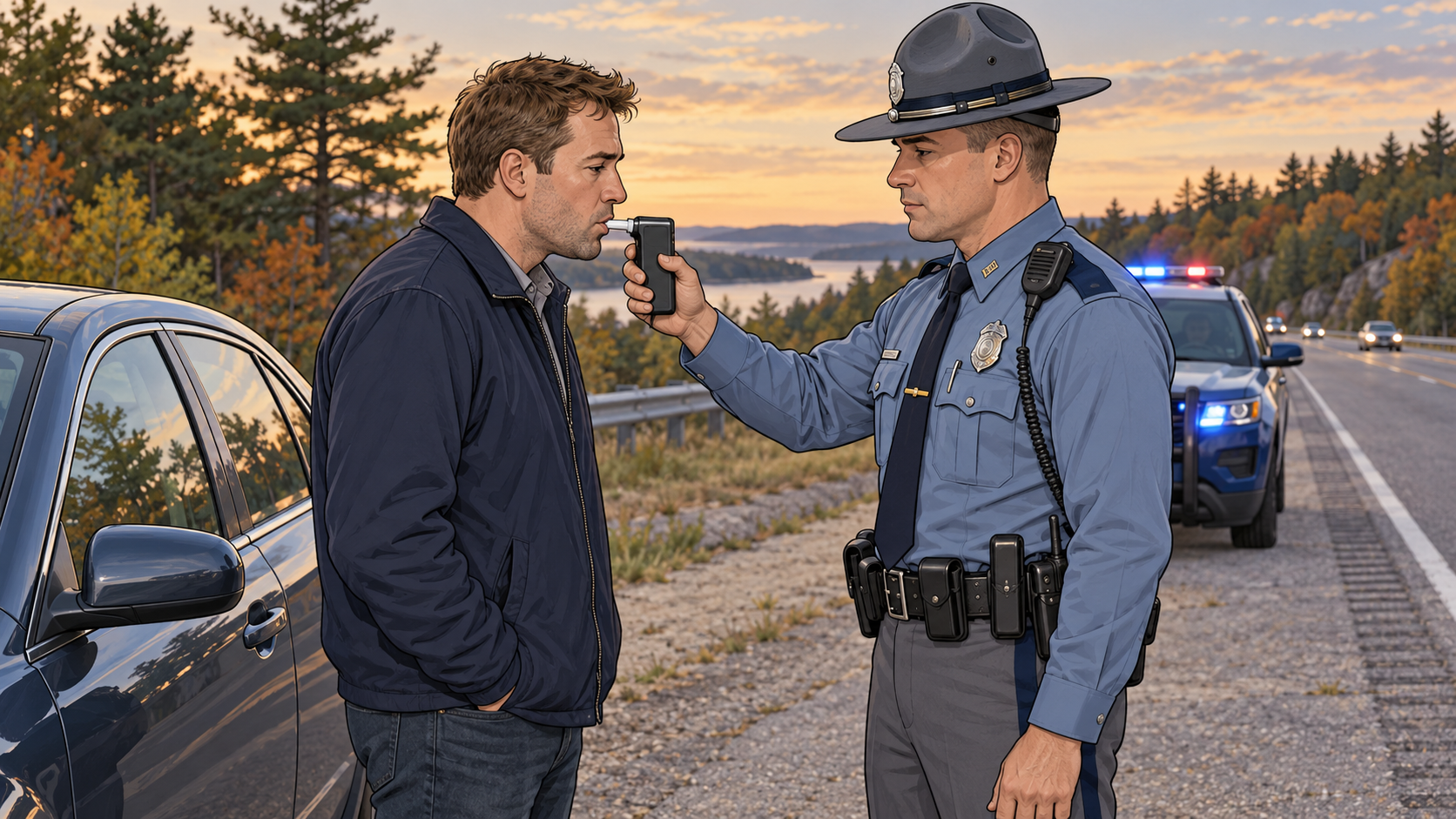
An officer may offer a portable breath test during a roadside investigation. This is the small handheld device shown in the illustration above. It helps the officer assess the situation before deciding whether to arrest you.
That screening test is different from the formal chemical breath test typically offered at the police station after an OUI arrest. The implied-consent refusal suspension discussed below concerns the post-arrest test requested under the statute; simply declining a voluntary pre-arrest roadside screening test does not itself trigger that suspension. See G.L. c. 90, § 24(1)(f)(1).
When I review a case, I identify each test separately: what was requested, when it was requested, what you were told, and how you responded. Calling everything “the breathalyzer” can obscure important differences.
What happens if I refuse the formal breath test?
Your refusal generally cannot be introduced as evidence of guilt at your Massachusetts OUI trial. That protection does not prevent the RMV from using the refusal in a license proceeding. The distinction appears directly in G.L. c. 90, § 24(1)(e).
Without a breath result, the prosecution may still rely on driving, observations, statements, video, and other evidence. Refusal changes the evidence available; it does not automatically end the case.
The license consequences deserve equal attention. The ordinary refusal periods are:
Certain prior serious-injury or fatal offenses carry special rules. Qualifying prior history may include an admission to sufficient facts or assignment to a program, so the analysis is not limited to convictions as people commonly understand that term. Refusal suspensions generally run consecutively to additional suspensions from the same incident. G.L. c. 90, § 24(1)(d), (f)(1).
I review the actual driving and court records before advising someone about the likely suspension. Drivers under 21 and commercial-license holders need additional analysis.
What happens if I take the test?
A properly admitted result of .08 or higher can support the prosecution's case without requiring separate proof that alcohol impaired your driving ability. Massachusetts also permits prosecution based on impairment, so a result below .08 does not automatically dispose of an OUI allegation. G.L. c. 90, § 24(1)(a)(1).
A low result can nevertheless be useful defense evidence. The question is what the result shows when considered alongside the driving, the officer's observations, and the rest of the record.
For a driver 21 or older, a test result of .08 or higher also triggers an immediate administrative suspension lasting until disposition of the charge or 30 days, whichever comes first. A later case disposition may bring additional license consequences. For a first-offense case, the decision whether to accept a CWOF or take the case to trial can also affect the practical consequences of the case and the client’s record. Read more about whether to take a CWOF or go to trial on a first Massachusetts OUI. Different thresholds and additional rules apply to younger drivers. G.L. c. 90, § 24(1)(f)(2).
So which choice is better?
From a defense perspective, avoiding an incriminating breath result can be valuable. From a licensing perspective, refusal can be costly—particularly for someone with prior offenses or someone under 21.
I would weigh both. A blanket instruction to always take the test or always refuse leaves out information that could change the answer. Your age, history, license status, and the circumstances of the stop all matter. How sober you feel is not a reliable way to predict the machine's result.
If you already took or refused the test, the useful next step is to evaluate the evidence and preserve your options. There may be substantial work to do on either type of case.
Can a breath-test result be challenged?
Yes. A number on a printout is not the end of the inquiry.
Massachusetts requires a certified operator, approved testing methods, and a qualifying breath-testing device. The statute also specifies a testing sequence that includes two adequate breath samples and a calibration-standard analysis. G.L. c. 90, § 24K.
I review the test records, operator and instrument certifications, maintenance information, and available booking video. I also examine the stop and arrest, which may present issues independent of the test itself.
The objective is to identify a specific problem that affects admissibility or reliability. That gives us a concrete basis for a motion or a challenge at trial.
What if I tried but could not complete the test?
Tell your lawyer exactly what happened, including any breathing difficulty, medical condition, instructions you did not understand, and requests for help. Preserve supporting medical records where relevant.
An unsuccessful attempt is not always treated like a simple verbal refusal. In Commonwealth v. Curley, 78 Mass. App. Ct. 163 (2010), the court permitted testimony about the defendant's conduct during failed attempts after he consented to testing. That makes the recording and the details of the interaction especially important.
What can I do now to protect my options?
Start by sending your lawyer the suspension notice, citation, release paperwork, and any breath-test printout. Write down what you remember about the test request and preserve relevant receipts, messages, and witness information.
A chemical-test refusal suspension has a short RMV review window: the statute provides for a hearing within 15 days of suspension. Contact counsel immediately so that opportunity can be addressed. The hearing concerns specific issues, including the officer's reasonable grounds, whether you were arrested, and whether you refused—not simply whether you need your license for work. G.L. c. 90, § 24(1)(g).
An ordinary hardship permit is not available during the refusal suspension. However, an acquittal or dismissal of the qualifying charges may open a route to request restoration from the court, subject to the statute's conditions and public-safety review. That relief requires action; it is not automatic. G.L. c. 90, § 24(1)(f)(1).
Get a plan for the case and your license
An OUI allegation can leave you worrying about court, work, and how to get through the coming weeks. Understanding the deadlines and separating the criminal case from the license issues makes the situation easier to manage.
If you took or refused a breath test after an OUI arrest, call Winn Law, P.C. at 857-415-2415 for a free, confidential consultation. I can review what happened, explain the available options, and begin preparing your defense. Learn more about my Massachusetts OUI and DUI defense practice.
From the Blog



Get in Touch
Over 50 five-star reviews on Avvo. For a free, confidential case assessment, tell us briefly what happened and how to reach you using the form below, or call (857) 415-2415
.svg)

.svg)
